What remains hidden to others, we make visible.
AVA-Stabilis provides read-only operational diagnostics that reveal where your organization loses time, money, capacity and control — without modifying existing systems.
Your systems may look stable while hidden losses, delays and capacity problems accumulate across the wider operation.
- Reveals bottlenecks, delays, rework and hidden capacity loss.
- Shows how local problems spread across departments, systems or service chains.
- Delivers an interpreted operational map and management-level improvement points.
Read-only · No workflow modification · No operational takeover
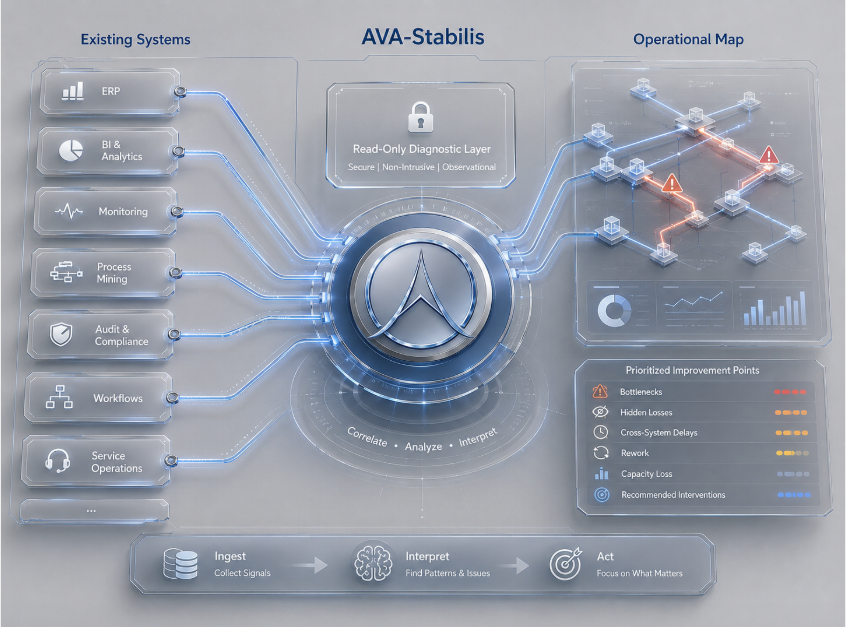
Schematic illustration — not a live client dashboard.
Operational diagnostics for decision-makers in complex organizations
Read-only assessment
Existing-system data
4–6 week pilot
Executive diagnosis
Facts behind the appearance.
Expert read-only operational audit and risk analysis for public and private organizations — without modifying existing systems.
AVA-Stabilis does not only reveal operational problems. It identifies the points where process, capacity, resource, timing or data-flow improvements can be considered.
Built for decision-makers in complex organizations
For decision-makers who already have systems and reports — but still need one clear answer: where is the organization actually losing performance and capacity?
Public administration & institutional decision-makers
For cities, ministries, agencies and municipal institutions, operational loss often hides between departments, service channels and legacy systems.
- Service paths become slow or fragmented.
- Back-office cases accumulate without clear root cause.
- Approvals and handovers delay decisions.
- Management receives reports, but not one operational map.
AVA-Stabilis helps public-sector decision-makers see where workflows, systems and decision points lose capacity — without modifying live systems.
Enterprise & corporate executives
The issue is rarely a missing system. It is that ERP, BI, CRM or monitoring rarely show how the full operation behaves across functions.
- Departments wait for each other.
- KPI reports look acceptable while lead times grow.
- Rework appears repeatedly but its origin is unclear.
- Manual workarounds hide real cost.
AVA-Stabilis helps corporate executives understand where time, money and capacity are lost between systems, departments and processes.
Consulting, ERP-integration & advisory executives
For consultancies, ERP partners and integrators, AVA-Stabilis adds a higher-value diagnostic layer above existing advisory and implementation work.
- Clients have systems but don't see where performance is lost.
- ERP or BI projects reveal data, not operational causality.
- Improvement recommendations are hard to prioritize.
- Transformations lack a clear before/after operating map.
AVA-Stabilis helps partners add a higher-value diagnostic layer to advisory, ERP, BI and transformation projects.
HPC, AI and digital infrastructure operators
In high-performance computing environments, AI inference systems, GPU clusters and federated infrastructures, operational loss often does not appear inside one component. It emerges between compute, data, storage, scheduling, workload, energy and operational layers.
- GPU or node utilisation may look acceptable while effective throughput remains lower than expected.
- Queue behaviour, storage wait, data wait or retry patterns may create hidden capacity loss.
- AI inference, batch workload or multi-tenant environments may show misalignment between latency, energy and resource usage.
- Monitoring shows components separately, but not one operational map of the full infrastructure.
AVA-Stabilis helps infrastructure operators understand how compute, data, scheduling, storage, energy and workload layers behave together — without controlling infrastructure or modifying live systems.
From operational audit to practical improvement points
AVA-Stabilis does not simply provide data or reports. By interpreting how the operation actually behaves, it helps identify where process, capacity, resource or management interventions may be needed.
Process planning and automation points
Streamlined operation. Fewer manual errors.
Based on the operational diagnosis, we identify where processes can be simplified, where automation points may be considered, and where capacity, resource or production planning can be improved.
Learn moreData visualization, BI and controlling support
From data to management insight.
Existing ERP, BI, PowerBI, controlling and management reports are placed into operational context, so they show not only numbers but decision-supporting relationships.
Learn moreEfficiency improvement and loss reduction
Less waste. Better capacity utilization.
We reveal bottlenecks, rework, delays, hidden capacity loss and process problems, then identify the points where intervention should first be considered.
Learn moreOperational audit and risk reduction
We create transparency. We reduce uncertainty.
Through read-only operational audits of public and private organizations, we help decision-makers gain a clearer view of hidden losses, process problems and operational risks.
Learn moreAI / HPC infrastructure diagnostics
research / pilot-preparation directionHidden capacity loss, queue behaviour, GPU utilisation and energy-efficiency interpretation.
For AI inference, GPU-cluster, HPC and federated infrastructure environments, AVA-Stabilis can create an interpreted, cross-layer operational map from existing operational traces such as job metadata, queue timestamps, workload labels, storage wait, retry/failure signals, GPU-utilisation summaries or energy aggregates — observer-only.
Not another ERP, BI or monitoring tool — an interpretation layer above them.
AVA-Stabilis does not replace existing tools. It uses them as sources of operational traces and adds an interpretation layer above them.
ERP
Shows: Transactions, process records, business events
Adds: Cross-process operational interpretation
BI
Shows: Aggregated metrics and dashboards
Adds: Context behind the numbers
Monitoring
Shows: Technical system health and incidents
Adds: Operational impact mapping
Process mining
Shows: Process execution from available event logs
Adds: Cross-system and cross-team interpretation
Audit / consulting
Shows: Compliance, risk or expert assessment
Adds: Read-only diagnosis from existing traces
The difference is not more data. The difference is an interpreted view of how the whole operation behaves.
What you receive
Not another dashboard. Not a generic consulting deck. AVA-Stabilis delivers an interpreted operational map of the selected organization, institution or process area.
The diagnosis provides not only a map, but recommended attention and intervention points for management.
- Where the organization loses time, money and capacity.
- Where bottlenecks and rework appear.
- Where cooperation between processes becomes distorted.
- Where change should first be considered.
- Which interventions may improve efficiency, transparency and capacity utilization.
Interpreted operational map
How systems, teams, processes and decision points interact in practice.
Hidden-loss diagnosis
Where time, capacity, stability or coordination is being lost.
Downstream-effect explanation
How local delays, rework or handover issues spread into other areas.
Management improvement points
Where management should first consider change.
Low-risk decision support
AVA-Stabilis recommends attention points; the client remains in control of decisions and implementation.
Why AVA-Stabilis is different
AVA-Stabilis does not evaluate one system in isolation. It interprets how systems, teams, processes and decision points interact across the real operation.
The same approach can also be applied to high-performance digital infrastructures, including AI inference systems, GPU clusters, HPC environments and federated computing infrastructures, where loss often appears through misalignment between operational layers.
Across systems, not inside one tool
Most tools show what happens inside their own domain. AVA-Stabilis connects traces across ERP, BI, monitoring, workflow, ticketing and operational data to reveal how the whole operating area behaves.
Operational causality, not only reporting
Dashboards show indicators. AVA-Stabilis helps explain where delay, rework, capacity loss or coordination failure originates and how it spreads.
Read-only by design
The first step can work from controlled exports, anonymized data, logs, timestamps or aggregated reports. AVA-Stabilis does not modify workflows or take over operations.
Built for executive decisions
The output is an interpreted operational map and recommended attention points — not raw data that executives still have to decode.
How a read-only pilot works
Select one operating area
Choose a clearly scoped process, service path, back-office flow, ERP process, workload segment or decision chain.
Work from controlled data
Use agreed, controlled and where possible anonymized exports, logs, timestamps, reports or workflow traces.
Receive the diagnosis
Get an interpreted map of losses, bottlenecks, downstream effects and recommended management attention points.
Easy to verify. Low risk to start.
AVA-Stabilis does not require a large transformation program to prove its value. A first pilot can start with one selected operational area and controlled data.
The first pilot is designed as a low-risk proof point: it shows whether existing data can reveal hidden losses, capacity problems or process relationships that current reports do not make visible on their own.
Typical first-step data sources
Agreed, controlled and where possible anonymized.
- ERP or workflow exports
- Ticket and status data
- Timestamps and lead-time data
- Aggregated reports
- Anonymized logs
- Queue / workload statistics
- Process handover records
Where we are now
AVA-Stabilis is prepared to demonstrate its operational diagnostic value in real organizational and digital environments. Pilot work, validations and professional discussions are currently taking place with domestic and international partners from both the private and public sectors.
Because the approach is new, we do not rely on long theoretical explanations. We show partners what AVA-Stabilis can reveal in their own operating environment — especially what existing ERP, BI, monitoring, audit or reporting systems do not make visible on their own.
AVA-Stabilis is also developing a dedicated research and validation direction for observer-only Operational Intelligence in federated HPC and AI infrastructures, including AI Factory, GPU-cluster, storage-pressure, energy-efficiency and hidden capacity-loss use cases.
This direction is currently presented as research, whitepaper and pilot-preparation work, not as a completed client validation or formal EuroHPC production result.
Some detailed industry materials connected to this site are partly modeled demonstration examples. They illustrate the methodology and the type of output AVA-Stabilis can produce; they are not presented as outcomes of completed client engagements.
Questions, answered
AVA-Stabilis is designed for decision-makers in complex organizations: public institutions, enterprises, municipalities, industrial operators, financial/service organizations, and consulting or ERP-integration partners.
Not necessarily. A first assessment can often start from exported, controlled, anonymized or aggregated data. The exact data framework is agreed in advance.
No. AVA-Stabilis does not write back, modify workflows or control operations. It provides analysis and recommendations; the client decides on any change.
No. These systems may provide useful input data. AVA-Stabilis adds an interpretation layer that focuses on operational relationships, hidden loss, bottlenecks and cross-system effects.
An interpreted operational map, hidden-loss and bottleneck diagnosis, downstream-effect explanation, and recommended management attention points for the selected area.
Start with one read-only pilot area. If the diagnosis reveals meaningful hidden loss or coordination problems, the organization can decide on the next step based on concrete findings.
Some examples are demonstration-oriented and partly modeled. They show the method and type of output. Real pilot and validation work is being developed with domestic and international private and public-sector partners.
A first scoped pilot is typically planned for 4–6 weeks, depending on the selected area and data availability.
Who is behind AVA-Stabilis
AVA-Stabilis is developed by a Hungarian founding team working at the intersection of operational diagnostics, digital systems, applied research and executive decision-support.
Mitró Csaba
Founder
Business development, partner relations and operational use-case coordination.
B. Tóth Csaba
Founder
Concept development, strategic positioning and AVA-Stabilis operational-intelligence framework.
Dienes István
Founder
Mathematical, analytical and research-oriented foundations of the AVA-Stabilis approach.
Research background
IARIP Institute
IARIP provides the research background for AVA-Stabilis, including applied work on operational intelligence, complex digital systems and next-generation diagnostic methods. IARIP also supports the research direction related to complex digital infrastructures, AI systems and federated HPC environments.
Request a short consultation
Tell us which operating area you would like to understand better. We will help identify whether a read-only diagnostic pilot could create value.